Jeju Island isn’t just volcanic landscapes and ocean views—it’s alive with culture that hits you in the feels. From ancient *haenyeo* divers to quiet village rituals, travelers stumble upon traditions that no guidebook prepares them for. This isn’t tourism; it’s connection. The island breathes with a rhythm all its own, shaped by wind, sea, and centuries of resilience. For those seeking real moments over checklist sightseeing, Jeju offers something rare: a chance to feel the soul of a place. Here, culture isn’t performed—it lives, quietly and deeply, in the hands of elders, the stones of village walls, and the tides that shape daily life.
First Glimpse: What Makes Jeju Culturally Unique?
Jeju Island, a volcanic jewel off the southern coast of South Korea, stands apart not only in geography but in spirit. Recognized by UNESCO for its unique cultural and natural heritage, the island is home to traditions that have evolved in isolation, shaped by its rugged terrain, unpredictable weather, and strong-willed people. Unlike the fast-paced urban life of Seoul or Busan, Jeju moves to the rhythm of nature—tides, seasons, and ancestral customs. This distinct identity is evident in every aspect of life, from the soft lilt of the local dialect to the dark volcanic stone that lines every path and home.
The island’s cultural uniqueness begins with its people. Jeju residents have long cultivated a sense of self-reliance, born from centuries of surviving harsh conditions and political marginalization. This independence is reflected in the matriarchal influences visible in many aspects of society, most famously in the *haenyeo*, the free-diving women who have sustained coastal communities for generations. Their existence challenges conventional gender roles and highlights a society where women have historically held economic and social power. This legacy continues to shape Jeju’s values—community, resilience, and harmony with the natural world.
Equally iconic are the *dol hareubang*, the stone grandfather statues scattered across the island. Carved from volcanic rock, these weathered figures once guarded village entrances and symbolized protection, fertility, and wisdom. Today, they serve as enduring emblems of Jeju’s spiritual heritage. Their stoic faces, chiseled with care centuries ago, remind visitors that this is a place where the past is not buried but lived. The language, too, tells a story of separation—Jeju-eo, the local dialect, is so distinct from standard Korean that linguists classify it as a separate language. Though its use has declined, efforts to preserve it reflect a deep commitment to cultural continuity.
What truly sets Jeju apart is its philosophy of balance. The island’s traditions emphasize coexistence—with the sea, the land, and each other. Homes are built low to withstand typhoon winds, walls are constructed without mortar, fitting stones together like a puzzle. This architectural wisdom speaks to a deeper truth: that survival here has always depended on working with nature, not against it. For the modern traveler, this offers a rare invitation—not just to observe, but to reflect on a way of life that values patience, humility, and respect.
The Haenyeo: Women Who Defy the Sea
At the heart of Jeju’s cultural identity are the *haenyeo*, the fearless female divers who harvest seafood from the island’s frigid waters without the aid of oxygen tanks. These women, often in their 60s, 70s, and even 80s, plunge into the sea at dawn, holding their breath for minutes at a time to gather abalone, sea urchins, and octopus. Their practice, passed down through generations, is more than a livelihood—it is a testament to endurance, sisterhood, and an intimate relationship with the ocean. In a world where traditional roles often confine women, the *haenyeo* stand as symbols of strength and autonomy.
Their history stretches back over 400 years, rooted in necessity. With men often lost at sea or conscripted, women took on the dangerous work of diving to feed their families. Over time, they formed tight-knit collectives, known as *bulteok*, where they warmed themselves between dives and shared stories, warnings, and wisdom. These shelters, simple stone huts perched on rocky shores, remain active today in villages like Hado and Seongsan. Visiting one at sunrise, one can witness the ritual: women in wetsuits (a modern upgrade from traditional cotton garments), adjusting their goggles, checking their weights, and offering quiet prayers before stepping into the waves.
Yet the *haenyeo* tradition faces an uncertain future. Fewer than 4,000 remain, most of them elderly, and younger generations are increasingly drawn to urban jobs and modern lifestyles. The physical demands of diving, combined with declining marine resources, make the profession less viable. UNESCO’s recognition of the *haenyeo* as an Intangible Cultural Heritage of Humanity in 2016 brought attention, but preservation requires more than awareness—it requires support, infrastructure, and renewed pride among the island’s youth.
For travelers, encountering the *haenyeo* is a humbling experience. It is not a performance staged for tourists but a daily act of survival and dignity. Some cultural centers offer opportunities to meet divers, hear their stories, and even try on replica gear. But the real lesson lies in observing their quiet discipline—the way they move with the tides, the way they care for one another, the way they speak of the sea not as a resource to exploit, but as a force to respect. In their presence, one understands that culture is not something to be consumed, but something to be honored.
Walking Through Living History: Stone Villages and Folk Villages
Scattered across Jeju’s rolling hills and coastal edges are villages built entirely from black volcanic stone, their walls winding like ancient serpents through the landscape. These are not ruins but living spaces—some homes still inhabited, others preserved as cultural landmarks. The most well-known, such as Jeju Folk Village in Jeongbang and O’Sulloc Tea Garden’s stone hamlet, offer a window into a way of life shaped by scarcity and ingenuity. Every stone was placed by hand, without mortar, stacked in patterns that withstand typhoons and time. To walk these paths is to step into a three-dimensional archive of Jeju’s architectural and spiritual wisdom.
The craftsmanship on display is both functional and symbolic. Walls are built low and curved to deflect wind, roofs are weighted with stones to prevent uplift, and doorways face south to capture sunlight. But beyond utility, the stones carry meaning. The *bangsatap*, or spirit stones, are small, cone-shaped structures placed at village entrances or crossroads to ward off evil spirits. Often overlooked by casual visitors, they are a quiet testament to the islanders’ belief in invisible forces and the need for spiritual protection. Similarly, the placement of homes, wells, and shrines follows principles of *pungsu*—Korean geomancy—ensuring harmony between people and their environment.
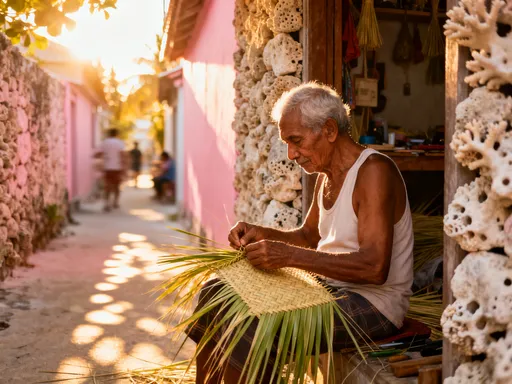
What makes these villages truly special is their role as cultural classrooms. Many now host workshops where visitors can try their hand at stone stacking, learn traditional thatching, or participate in ancestral rites. In one village, a retired fisherman teaches children how to weave fishing nets using age-old techniques. In another, a grandmother demonstrates how to prepare *heukdwe-chae*, a dish made from black seaweed harvested from nearby rocks. These experiences go beyond observation—they invite participation, fostering a deeper appreciation for the skills that sustained Jeju for centuries.
Yet preservation is an ongoing challenge. Modern construction, tourism development, and depopulation threaten the integrity of these historic spaces. Some villages have been over-restored, losing their authenticity in favor of tourist appeal. The most meaningful visits are those that prioritize respect—staying on marked paths, speaking softly, and supporting local guides who are descendants of the original inhabitants. In doing so, travelers help ensure that these villages remain not as museums, but as living testaments to Jeju’s enduring spirit.
Seasonal Rhythms: Festivals That Tell Stories
Life on Jeju unfolds in cycles dictated by nature and myth. The island’s calendar is marked not by commercial holidays but by seasonal rituals that honor the sea, the soil, and the ancestors. These festivals are not grand spectacles designed for mass tourism, but intimate gatherings rooted in gratitude, prayer, and community. They reflect a worldview in which humans are not masters of nature but participants in its rhythms. For the attentive traveler, these events offer a rare glimpse into the island’s spiritual heartbeat.
One of the most renowned is the Jeju Fire Festival, held in spring on the slopes of Seongsan Ilchulbong. Though it now draws large crowds, its origins are humble—a ritual in which farmers burned dried grass to enrich the soil and ward off pests. The flames were believed to carry prayers for a bountiful harvest and protection from harm. Today, controlled bonfires still light up the night, accompanied by traditional music and dance. But the deeper meaning remains: fire as a purifier, a renewer, a bridge between the earthly and the divine.
Equally significant are the lesser-known shrine rituals, such as those at Seolbalbon Dang, a sacred site dedicated to local deities who protect fishermen. During the annual *dangje*, villagers gather to offer food, burn incense, and perform shamanistic rites led by a *simbang* (Jeju shaman). The air fills with the scent of pine and roasted barley, and the sound of drums echoes across the hills. These ceremonies are not open to public performance; photography is often discouraged, and participation is reserved for locals. Yet even as an observer, one can feel the weight of devotion—the way elders bow deeply, the way children hold their breath during invocations.
Other festivals mark the fishing season, the tea harvest, or the equinoxes. The *Buldal Nori*, or Lantern Play, takes place in autumn, when paper lanterns are released into the sea as offerings to lost souls. The *Onggi Festival* celebrates the island’s pottery tradition, with demonstrations of clay gathering and kiln firing. Each event tells a story—not of conquest or celebration, but of dependence, humility, and remembrance. For visitors, the key is not to seek entertainment but to practice restraint: to watch quietly, to listen, and to recognize that some moments are not meant to be captured, only felt.
Craftsmanship in Motion: Hands-On Cultural Experiences
Understanding Jeju’s culture is not a passive act. It requires engagement—hands in clay, feet on volcanic soil, ears tuned to an unfamiliar dialect. Across the island, a growing number of cultural programs invite travelers to move beyond observation and into participation. These are not staged performances but real, often humble, acts of preservation. Whether shaping pottery, harvesting tea, or preparing a meal with elders, these experiences create connections that last far longer than photographs.
One of the most memorable is the traditional cooking workshop in a rural village. Here, a group of women in their 60s teaches visitors how to make *black stone soup*, a hearty stew cooked in a pot carved from basalt. The process begins with gathering ingredients—wild greens from the hills, dried anchovies, and freshly caught shellfish. The pot, blackened by generations of use, is placed over an open fire. As it simmers, the women share stories—of childhood winters, of lost loved ones, of how this dish once fed entire families during lean years. The soup itself is simple, but the act of making it together transforms it into something sacred.
Other workshops focus on *ojing’eo* (squid) fishing, a nighttime tradition where lanterns are lowered into the water to attract squid. Armed with poles and nets, families and visitors work side by side, laughing as they haul up slippery catches. The squid are then grilled on the spot, eaten with rice and *doenjang* (fermented soybean paste). It’s messy, unpredictable, and utterly real. No scripts, no costumes—just people doing what they’ve done for generations.
For those drawn to craft, Jeju’s pottery studios offer hands-on lessons using local red clay, rich in iron and volcanic minerals. Artisans demonstrate coiling and hand-building techniques, explaining how each piece is shaped to withstand the island’s humid climate. Some studios allow visitors to take their creations home after firing—a small but meaningful souvenir that carries the weight of effort and intention. These experiences, though brief, shift the traveler’s role from outsider to participant, from consumer to contributor.
Off-the-Beaten-Path Encounters: Where Culture Breathes Quietly
While tourist maps highlight waterfalls, lava tubes, and tangerine farms, the true essence of Jeju often lies beyond them—in nameless hamlets, family-run tea fields, and village wells where women still gather to wash clothes. These are not attractions but living spaces, where culture is not performed but lived. To find them requires slowing down, stepping off paved paths, and embracing the unexpected.
One such moment might unfold in a quiet valley where a multi-generational family tends a green tea plantation. The leaves are hand-picked each spring, dried in the sun, and stored in clay jars. There is no shop, no signage—only a wooden bench and a kettle always on the stove. When visitors arrive, they are offered tea not as a transaction but as a gesture of hospitality. As the elder pours, steam rising in delicate curls, she speaks of her grandmother’s hands, of droughts and typhoons, of how tea connects them to the land. No admission fee, no schedule—just time, shared.
Another encounter might happen at a village well, where a woman in a wide-brimmed hat draws water for her garden. She nods in greeting, continues her work, and after a while, offers a cup from her ladle. The water is cool, faintly mineral, drawn from the same aquifer that has sustained the village for centuries. There is no performance, no expectation—only presence. These moments, fleeting and unscripted, are where authenticity thrives. They remind us that culture is not something to be consumed, but something to be entered into with humility and openness.
Exploring these spaces requires mindfulness. Roads may be unpaved, signage minimal. Some areas are marked as restricted out of respect for privacy or sacredness. The reward is not a photo, but a feeling—a sense of having touched something real. It is in these still places that Jeju reveals its deepest magic: not in grand vistas, but in quiet acts of continuity, in the way a grandmother teaches a grandchild to fold dumplings, or how neighbors leave baskets of tangerines on each other’s porches.
Traveling with Respect: How to Engage, Not Disrupt
With growing interest in cultural tourism, the risk of disruption increases. Jeju’s traditions are not exhibits; they are lived realities, fragile and precious. Travelers have a responsibility to engage mindfully—to listen more than speak, to observe without intruding, and to support without exploiting. Respect is not a suggestion; it is the foundation of meaningful travel.
Simple actions make a difference. Learning a few phrases in Jeju-eo, such as *“jeongmal gamsahabnida”* (thank you), shows effort and appreciation. Dressing modestly when visiting shrines or villages—covering shoulders and knees—acknowledges sacred spaces. Avoiding loud conversations or intrusive photography, especially during rituals, preserves the dignity of the moment. When in doubt, follow local cues: if others are silent, be silent; if they bow, bow; if they refrain from taking pictures, do the same.
Supporting local artisans, family-run guesthouses, and small restaurants ensures that tourism benefits the community directly. Buying a handmade stone carving from a village craftsperson, rather than a mass-produced souvenir from a chain store, sustains tradition. Staying in a *hanok* (traditional house) managed by a Jeju family offers not just lodging but connection. These choices, though small, contribute to a tourism model rooted in reciprocity rather than extraction.
Equally important is the willingness to let go of control. Not every experience will be convenient or photogenic. Some moments will be uncomfortable—cold water, language barriers, uncertainty. But it is in these spaces that growth happens. To travel with respect is to accept that one is a guest, not a customer. It is to leave spaces as they were found—clean, undisturbed, and honored.
Conclusion: Carrying Jeju’s Spirit Forward
Jeju Island does not reveal itself all at once. Its magic lies not in postcard views, but in the quiet moments—the sound of waves against volcanic rock, the laughter of *haenyeo* warming their hands by a fire, the taste of tea shared without words. To travel here is not to collect sights, but to gather feelings, to let the island reshape one’s understanding of what it means to belong, to endure, to connect.
In a world that often values speed and spectacle, Jeju offers a different rhythm—one of patience, presence, and respect. Its culture is not a performance for outsiders, but a living tradition carried forward by those who call it home. For the thoughtful traveler, the journey becomes a practice in humility: to listen, to learn, and to leave with gratitude.
The true legacy of a visit to Jeju is not what one takes home, but what one carries forward—the memory of a hand-carved stone, the echo of a folk song, the realization that the most profound journeys are not measured in miles, but in moments of quiet connection. In seeking depth over distance, stillness over speed, travelers do more than explore a place—they honor it. And in doing so, they become part of its story, however briefly, however quietly.