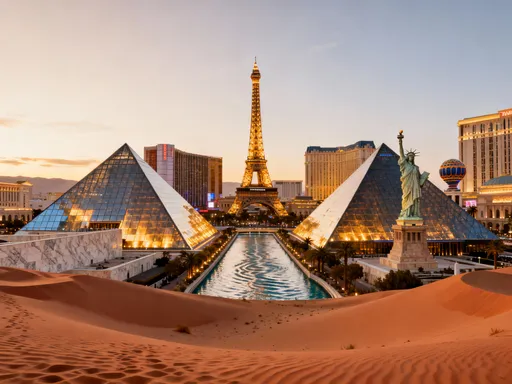
Las Vegas isn’t just about casinos and shows—its architecture will blow your mind. From pyramid-shaped hotels to European castles on the Strip, the city’s skyline defies logic. I was stunned walking past a Venetian canal with gondoliers singing under fake skies. This is a place where imagination runs wild, blending art, fantasy, and engineering. If you think Vegas is all flash, think again—its buildings tell stories worth exploring.
The Strip as an Architectural Playground
Las Vegas Boulevard, commonly known as the Strip, functions less like a street and more like an open-air museum of architectural ambition. Every resort lining this stretch of desert highway is a statement—a declaration of identity crafted not just to house guests, but to captivate them from the moment they arrive. The competition among resorts has long fueled a race toward greater spectacle, pushing designers and developers to construct increasingly elaborate facades and immersive environments. Unlike most cities where architecture evolves gradually, the Strip has been shaped by deliberate, high-stakes decisions to stand out in a landscape where visibility means survival.
Take the Luxor Hotel, a towering black glass pyramid rising from the Nevada sand. Its angular silhouette is unmistakable, culminating in a powerful beam of light that shoots into the night sky—one of the brightest artificial beams on Earth. This isn’t merely a shape; it’s a symbol of mystery and grandeur, drawing inspiration from ancient Egypt while being a marvel of modern construction. The pyramid’s form serves both aesthetic and functional purposes: its sloped walls reduce wind resistance, and its internal atrium allows for efficient air circulation in the desert heat. Yet few visitors pause to consider the engineering behind it—they’re too busy marveling at the illusion.
What sets the Strip apart is how each resort commits fully to a theme, transforming itself into a destination within a destination. These are not subtle nods to faraway places but bold, full-scale recreations designed to transport guests instantly. The Venetian replicates the canals of Venice with indoor gondola rides beneath a painted sky that mimics sunrise, noon, and sunset. At Paris Las Vegas, the Eiffel Tower stands at two-thirds scale, offering panoramic views and romantic dining, while Caesars Palace evokes imperial Rome with marble columns, fountains, and statues that line its grand entrance. These themes aren’t arbitrary—they’re carefully chosen to appeal to universal fantasies of romance, adventure, and luxury.
And then there’s the contrast. Surrounded by the arid Mojave Desert, where natural landmarks are sparse and colors muted, these vibrant, oversized structures seem almost alien. A Venetian canal shouldn’t exist here. A pyramid shouldn’t cast shadows over a casino floor. And yet, they do—defying geography, climate, and expectation. This dissonance is part of the magic. The desert backdrop, often overlooked, actually amplifies the impact of these creations. Against the beige horizon, every color appears brighter, every shape more dramatic. The environment doesn’t compete with the architecture—it frames it.
Themes That Define the Skyline
Walk along the Strip, and you’ll travel through time and space without ever leaving Nevada. One moment you’re in ancient Egypt at the Luxor, the next you’re strolling through a simulated Parisian boulevard complete with café tables and street performers posing as statues. These thematic identities are not just decorative—they are central to how each resort markets itself and shapes the guest experience. Architects and designers work closely with branding teams to ensure that every detail, from the shape of door handles to the pattern of floor tiles, reinforces the chosen narrative.
The Egyptian theme at Luxor extends beyond the pyramid. Inside, hieroglyphic motifs adorn walls, sphinx statues guard entrances, and dim lighting creates an atmosphere of archaeological discovery. Even the escalators descend at an angle through the core of the pyramid, mimicking the experience of entering a tomb. At Caesars Palace, Roman grandeur is on full display. The Forum Shops feature a retractable glass ceiling that simulates daylight, while artificial clouds drift across the interior sky. Statues of emperors and goddesses stand in niches, and water flows through ornamental fountains, evoking the opulence of ancient Rome. The attention to detail makes it easy to forget you’re in a shopping mall rather than the heart of an empire.
Then there’s The Venetian, where canals wind through the casino floor, complete with gondolas rowed by singing gondoliers dressed in traditional attire. The ceiling is painted to resemble a Mediterranean sky, transitioning through time-lapse sequences of dawn, midday, and dusk. Bridges modeled after those in Venice connect different sections of the resort, and the sound of lapping water adds to the sensory immersion. It’s not just a hotel—it’s a performance, and guests are both audience and participant.
Paris Las Vegas takes a different approach, focusing on romanticism and elegance. The half-scale Eiffel Tower is one of the most photographed landmarks in the city, offering observation decks and a fine dining restaurant at its base. The surrounding plaza includes cobblestone pathways, French-style lampposts, and even a re-creation of the Louvre’s courtyard. At night, the tower is illuminated with dynamic light shows, turning it into a beacon of European charm in the middle of the desert. These themes succeed because they tap into deeply held cultural imaginations—places people have dreamed of visiting, even if they’ve never been.
Even newer developments continue this tradition of thematic storytelling, though with a more contemporary twist. The Sphere, which opened in 2023, represents a shift toward abstract, technology-driven design. Rather than imitating a foreign city or historical era, it presents a futuristic vision—a massive spherical structure covered in an exosphere of LED panels capable of displaying moving images visible from miles away. Inside, the immersive audio-visual experience redefines entertainment architecture. It’s not about recreating the past but imagining the future. Yet, in its own way, it continues the Strip’s legacy of architectural audacity.
Beyond the Obvious: Hidden Design Details
While the grand facades and landmark structures capture attention, some of the most impressive architectural work in Las Vegas happens behind the scenes—or rather, above, beneath, and all around, unnoticed by most visitors. The true artistry lies in the details: the intricate ceiling designs, the carefully calibrated lighting, the flow of foot traffic guided by subtle spatial cues. These elements don’t scream for attention; they work quietly to shape mood, influence behavior, and enhance comfort.
At the Bellagio, for example, the lobby ceiling features a breathtaking glass sculpture by artist Dale Chihuly. Composed of thousands of hand-blown glass pieces in shades of blue, green, and gold, it resembles a swirling garden of underwater flora. From below, it looks like a living canopy, shifting in color as light passes through. Few guests realize the engineering involved—how the structure is suspended from the ceiling, how weight distribution was calculated, or how maintenance crews access it without disrupting the space. Yet its presence elevates the entire experience, adding a layer of sophistication that complements the resort’s reputation for elegance.
At Aria Resort & Casino, the design philosophy shifts toward minimalism and geometric precision. The exterior features clean lines and reflective glass, while the interior uses open spaces, natural light, and neutral tones to create a sense of calm. The floor patterns guide guests intuitively toward elevators, restaurants, and the casino floor, reducing confusion in a large, complex building. Lighting is carefully modulated—brighter in high-traffic areas, softer in lounges and corridors—to influence pace and mood. Even the acoustics are engineered: sound-absorbing materials reduce noise levels, making conversations easier and stress levels lower.
Another often-overlooked detail is the use of climate control in outdoor spaces. At The Venetian’s canals, misting systems and shaded walkways help keep temperatures comfortable despite the desert heat. At Wynn Las Vegas, outdoor gardens are irrigated with recycled water and planted with drought-resistant species, blending sustainability with beauty. These choices reflect a deeper level of planning—one that considers not just how a space looks, but how it feels to move through it.
Even the slot machine layouts are part of the architectural strategy. In many resorts, the casino floor is designed like a maze, with no clear sightlines to exits, encouraging longer stays. High-limit rooms are tucked away, offering privacy and exclusivity, while popular attractions are placed deep within the property, ensuring guests pass by other revenue-generating areas. None of this is accidental. Every inch of space is analyzed for psychological and behavioral impact. The result is an environment that feels inviting, exciting, and just a little bit disorienting—all by design.
Old Vegas vs. New Vision: Downtown’s Evolution
While the Strip showcases architectural spectacle on a grand scale, downtown Las Vegas tells a different story—one of reinvention, resilience, and cultural reawakening. Once the heart of the city’s gambling industry, downtown faded in the shadow of the Strip’s glittering megaresorts. But in recent years, it has undergone a remarkable transformation, blending vintage charm with creative innovation. The contrast between old and new is not a clash but a conversation—one that reveals the deeper layers of Las Vegas’s identity.
The Golden Nugget, established in 1946, stands as a testament to classic Vegas. Its exterior is modest compared to the Strip’s giants, but its interior buzzes with energy. The resort features one of the last remaining downtown casinos with a genuine local clientele. Its signature attraction, the Tank, is a multi-level aquarium filled with sharks and tropical fish, visible from guest rooms, the pool deck, and the casino floor. The building’s layout reflects an older style of hospitality—one where intimacy and accessibility mattered more than scale. Yet even here, updates have been made: modern amenities, refreshed rooms, and improved dining options keep it competitive.
Fremont Street, the historic core of downtown, has become a canvas for reinvention. The Fremont Street Experience, a pedestrian mall covered by a massive LED canopy, hosts light and sound shows every hour after sunset. The displays, synchronized to music, transform the sky into a dynamic spectacle of color and motion. But beneath the digital dazzle, vintage neon signs from the 1950s and 60s still glow—remnants of a bygone era when Vegas was smaller, grittier, and more personal. These signs, preserved and restored, serve as a bridge between past and present, reminding visitors that the city’s roots run deeper than any pyramid or gondola ride.
At the same time, new developments are redefining what downtown can be. The Arts District, located just east of downtown, has emerged as a hub for local creativity. Former warehouses and industrial buildings have been repurposed into galleries, boutiques, coffee shops, and craft breweries. Murals cover building exteriors, turning streets into open-air exhibitions. Events like First Friday, a monthly street festival, draw locals and tourists alike, celebrating music, food, and independent art. This shift reflects a growing desire to see Las Vegas not just as a tourist destination, but as a living, evolving community.
The contrast between the Strip and downtown is instructive. The Strip is about escape—about stepping into someone else’s fantasy. Downtown, increasingly, is about authenticity—about experiencing the real culture of Las Vegas. It’s where locals gather, where artists create, where history and innovation coexist. For travelers seeking a fuller understanding of the city, a visit to downtown offers balance and perspective. It proves that Las Vegas is not just a collection of themed resorts, but a place with memory, character, and soul.
Engineering Wonders Behind the Fantasy
Beneath the glitter and glamour of Las Vegas’s architecture lies a foundation of cutting-edge engineering. These buildings are not just visually stunning—they are feats of technical innovation, designed to function in one of the most challenging environments in the United States. The Mojave Desert brings extreme heat, limited water, and strong winds, yet the city’s resorts operate year-round with seamless comfort. Achieving this requires sophisticated systems, advanced materials, and bold structural solutions.
One of the most impressive examples is The Sphere, a 366-foot-tall spherical venue that pushes the boundaries of what architecture can do. Its exterior, known as the Exosphere, is covered in 580,000 square feet of LED panels—more than any other building in the world. These panels display high-resolution imagery that can simulate anything from star fields to cityscapes. But the real marvel is inside. The interior dome is equipped with a 16K resolution screen that wraps around the audience, combined with a 4D audio system that delivers sound with pinpoint precision. Every seat is engineered to provide an immersive experience, whether for a concert, a film, or a live broadcast.
The structural integrity of The Sphere is equally remarkable. Built to withstand seismic activity and high winds, it uses a space frame design made of steel trusses that distribute weight evenly. The absence of internal support columns allows for unobstructed views, but it also means the entire load must be carried by the outer shell. Engineers used advanced modeling software to simulate stress points and optimize the design before construction began. The result is a building that is both delicate in appearance and incredibly strong—a paradox made possible by modern engineering.
Other resorts rely on equally impressive technology. The retractable roof at T-Mobile Arena, home to major sporting events and concerts, can open or close in under ten minutes, allowing for both indoor and outdoor configurations. The Bellagio’s famous fountains operate through a network of 1,214 nozzles and 192 lights, controlled by a computer system that synchronizes water movement with music. Even the climate-controlled environments of indoor attractions like the Venetian’s canals require massive HVAC systems, insulated glass domes, and energy-efficient cooling methods to maintain comfort.
Sustainability is also becoming a priority. Many newer buildings incorporate solar panels, energy-efficient lighting, and water recycling systems. The Cosmopolitan, for example, uses a closed-loop water system for its fountains and pools, reducing waste. The Mandalay Bay complex includes a 22-acre solar array on its roof, one of the largest in the city. These innovations show that Las Vegas is not just about excess—it’s also about adaptation and responsibility. The city’s architecture must not only dazzle but endure.
Walking the City: A Tourist’s Guide to Seeing More
To truly appreciate Las Vegas’s architecture, you need to slow down and look up. Most visitors rush from casino to restaurant, show to hotel, barely noticing the structures around them. But with a little planning, a walk along the Strip can become a journey through design, history, and imagination. The best time to explore is early morning or late evening, when the sun is low and the lighting enhances textures and shapes. At sunrise, the glass towers reflect golden hues; at night, they glow with vibrant colors, revealing details invisible during the day.
Start at Mandalay Bay in the south and walk northward. This route allows you to experience the evolution of architectural styles—from the sleek modernity of Delano and THEhotel to the thematic extravagance of Luxor, Excalibur, and New York-New York. Each resort offers a distinct visual language, and seeing them in sequence highlights how design trends have shifted over decades. Take time to step inside lobbies and public areas. Many resorts welcome visitors even if they’re not guests. The atrium at Aria, the floral ceiling at Bellagio, and the Roman statues at Caesars are worth seeing up close.
Use a mobile app like Google Maps or the Las Vegas App to identify buildings and learn about their history. Some apps offer self-guided audio tours that explain architectural features and construction facts. Wear comfortable shoes—walking the entire Strip can cover four miles or more. Bring water, especially in summer, when temperatures regularly exceed 100°F (38°C). Consider taking breaks at outdoor plazas, rooftop bars, or hotel gardens to rest and absorb the surroundings.
Don’t limit yourself to the Strip. Visit downtown to see the contrast between old and new. Walk under the Fremont Street Experience canopy during a light show. Explore the Arts District on a weekend to see local art and culture in action. These areas offer a different kind of beauty—one rooted in authenticity rather than illusion. By combining both sides of the city, you gain a more complete picture of what Las Vegas truly is.
Why Architecture Makes Vegas Worth Revisiting
Las Vegas is often dismissed as shallow—a city built on illusion, excess, and temporary thrills. But its architecture tells a different story. These buildings are not just facades; they are expressions of human creativity, ambition, and technical mastery. They represent the desire to dream big, to build something that defies logic and leaves a mark. To visit Las Vegas and only see the shows and casinos is to miss half the experience. To understand its architecture is to see the city as a living laboratory of design.
Each resort is a world unto itself, crafted with purpose and precision. Whether inspired by ancient civilizations, European capitals, or futuristic visions, these structures invite us to step outside our everyday reality. They remind us that imagination has weight, that fantasy can be built in steel and glass. And for families, couples, and solo travelers alike, there is a quiet joy in discovering these details—the curve of a staircase, the pattern of a ceiling, the way light plays across a fountain.
Vegas rewards repeat visits because it never stops evolving. New buildings rise, old ones are renovated, and artistic visions shift with the times. The Sphere did not exist five years ago. Tomorrow may bring something even more astonishing. This constant reinvention keeps the city fresh, challenging visitors to look again, to see deeper, to appreciate the craftsmanship behind the spectacle.
So the next time you find yourself on the Strip, pause. Look up. Let your eyes trace the lines of a pyramid, the arch of a bridge, the glow of a digital sky. Feel the cool marble under your hand, listen to the echo of footsteps in a grand hall, watch the water dance in time to music. These are not just moments of leisure—they are encounters with art, engineering, and human ingenuity. Las Vegas, for all its flash, is ultimately a tribute to what people can create when they dare to imagine the impossible. And that, perhaps, is the most magical show of all.